Teaching simple interest with classroom loans
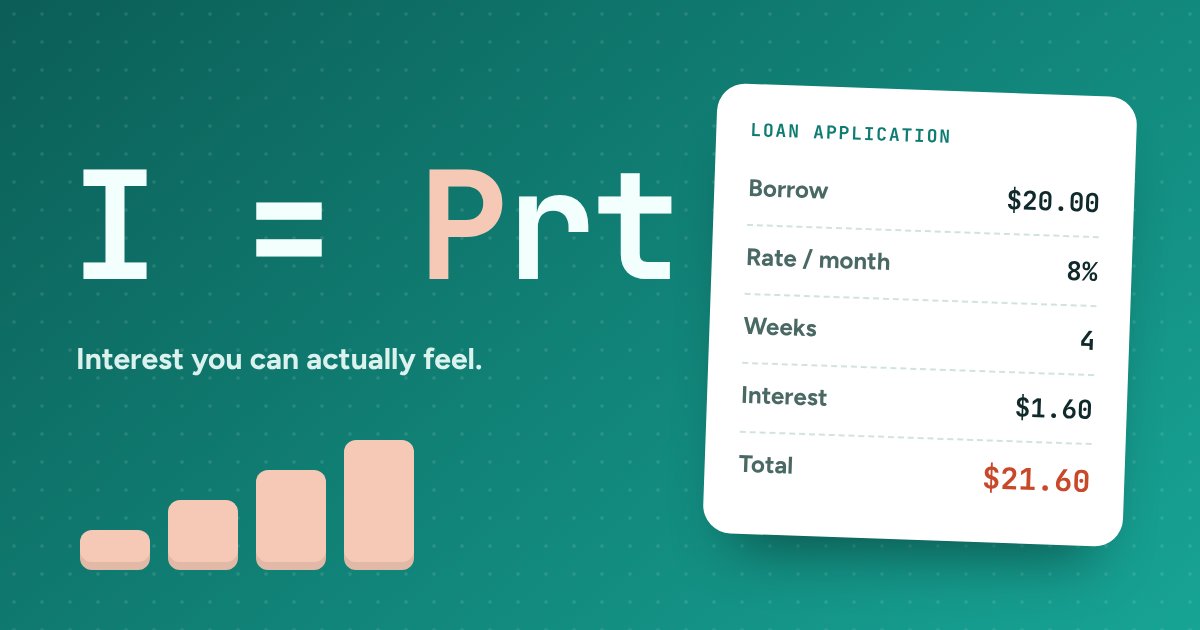
Simple interest is one formula, I = Prt, and most students can plug numbers into it by the end of one lesson. What they usually can't do is tell you whether a loan is a good deal. Class loans fix that, because the P is their money and the deal is theirs to take or leave.
Set up loans that keep the math clean
A few choices make classroom loans friendly to middle school math:
- Monthly rates, not yearly. An 8% monthly rate on $20 gives interest students can find mentally. Do tell them real loans quote a yearly rate (APR), and that 8% a month would be a terrible deal outside school.
- A short "month." If a class month is 4 weeks, then t = weeks ÷ 4, and loan terms of 2, 4, 6, or 8 weeks give t values of 0.5, 1, 1.5, and 2. Students practice decimals and fractions of time without noticing.
- Weekly payments. Payments line up with payday, so students feel the trade-off every Friday.
- Limits tied to income and credit. Requiring a job and capping the weekly payment at a share of weekly pay keeps students from borrowing more than they can repay, which is a lesson by itself.
The worked example
A student borrows $20 at 8% per month for 4 weeks.
I = P × r × t = 20 × 0.08 × 1 = $1.60
Total to repay = 20 + 1.60 = $21.60
Weekly payment = 21.60 ÷ 4 = $5.40
Have students calculate the interest and total before the loan is approved. If they can't explain what they're agreeing to, they aren't ready to sign.
The rounding question everyone asks
Sooner or later a total won't divide evenly. Borrow $100 at 4% per month for 6 weeks:
I = 100 × 0.04 × 1.5 = $6.00, total $106.00
106.00 ÷ 6 = 17.666... → $17.67 a week
5 × 17.67 = 88.35, so the last payment is 106.00 − 88.35 = $17.65
Students always ask where the extra pennies go. That's a great question to answer out loud: the first payments round up, and the last payment is whatever's left, so the total comes out exact. Many real loans settle the leftover cents in the final payment the same way.
Compare two offers
This is where interest stops being a formula and becomes a decision. A student needs $50:
| Rate | Term | Interest | Weekly payment | |
|---|---|---|---|---|
| Offer A | 6% / month | 4 weeks | $3.00 | $13.25 |
| Offer B | 4% / month | 8 weeks | $4.00 | $6.75 |
The lower rate costs more, because time matters as much as rate. And the cheaper loan has a payment twice as big. If a student earns $25 a week and payments are capped at 40% of pay ($10), Offer A isn't even available to them. It is the same trade-off people weigh on a car loan.
Paying off early
If interest is charged only for the weeks a student actually held the loan, paying early saves money, and students can prove it. Take $100 at 4% for 8 weeks: interest $8.00, payments $13.50. After three on-time payments ($40.50), the student pays off the rest at the three-week mark:
Owed = 103.00 − 40.50 = $62.50
Saved = 8.00 − 3.00 = $5.00
Practice before the real thing
Our free simple interest practice sheet has eight loan problems built on these ideas, including the rounding, comparison, and early payoff problems above, with a full answer key. Use it the week before loans open, and the first real application becomes the assessment.
In Cashroom, students do this math on the loan application itself: they work out the interest and the total before it sends, then pay weekly or turn on autopay, and their credit score responds to how it goes.
Keep reading
 4 min
Why students should calculate their own balances
When an app does the adding, a classroom economy teaches spending. When students do it, it teaches decimals, integers, and percents all year long.
Read it
 6 min
How to start a classroom economy in middle school: a four-week plan
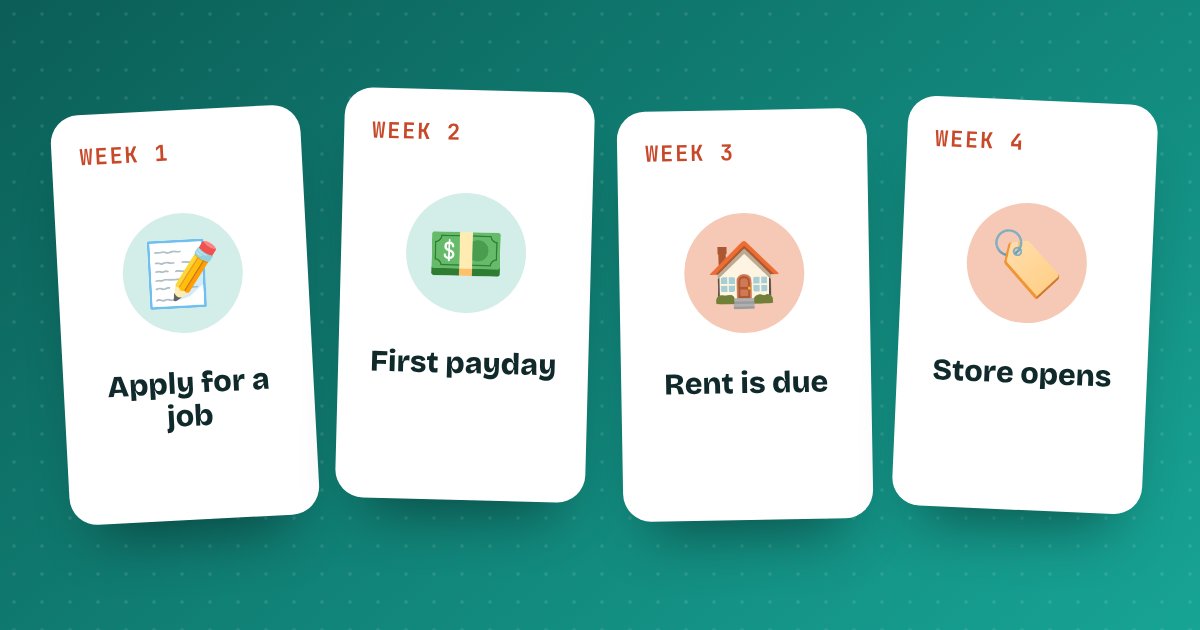
Roll out jobs, paydays, bills, and the store in layers so 12- and 13-year-olds actually buy in, plus the three numbers to settle before day one.
Read it